Artificial intelligence has read more about how children learn math than any human ever could -- thousands of studies, textbooks, and classroom results, across dozens of languages.
So we decided to ask the four leading AI models a simple, honest question:
“You're a child education expert. What's the most effective way for parents and educators to teach a young child to count to 100? And does the set of number words a language uses make counting easier or harder to learn -- if so, which systems help most, and why?”
A quick note before the answer:
AI isn't an oracle, and it can't “prove” anything. What it
is good at is reflecting the sum of what humanity has actually figured out. So when it keeps returning the same answer to a fair question, that tells you something real about where the evidence points.
What the AI said
We put the question to Claude, ChatGPT, Grok and Gemini — four of the leading AI systems. Every one of them landed in the same place. Claude's answer was the most detailed, so we'll start there. It walked through the developmental research on how young children learn to count, and then landed here:
So the systems that help most are the transparent base-10 ones… In Mandarin (and Cantonese, Korean, Japanese), the words are transparent: 11 is literally “ten-one,” 24 is “two-ten-four.” The name is a spoken instruction for building the quantity, so the child generates the sequence by rule instead of memorizing it item by item. English hides that structure exactly where it's being learned.
— Claude
It even drew us a picture. Below ten, every language is about equally easy; the trouble starts in the teens and the high decades — exactly where English (and French, and German) stop being regular:
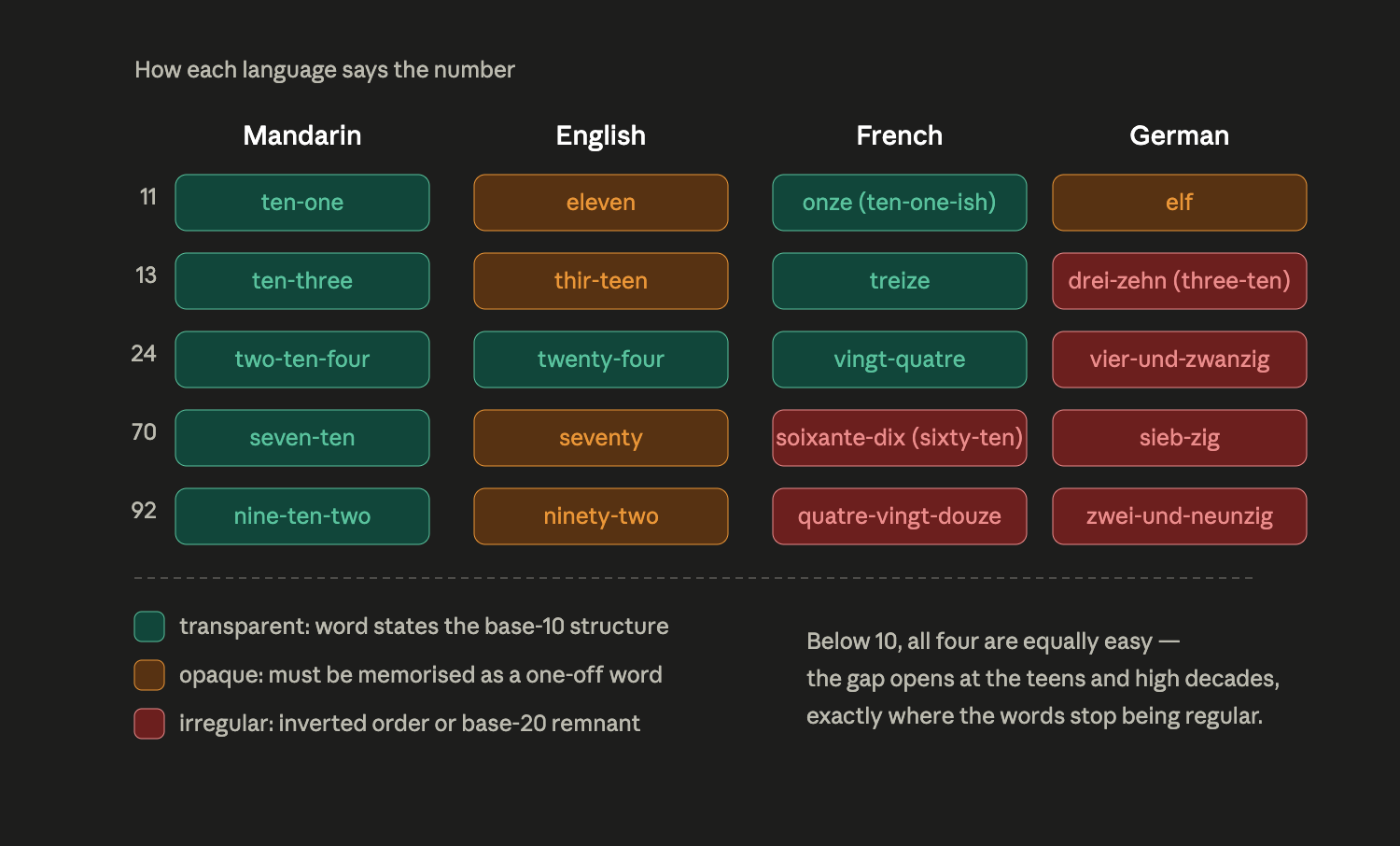
Chart generated by Claude. Green = the word states the base-10 structure; the gap opens exactly where the words stop being regular.
Then we asked it to choose, head-to-head: for a 4–6 year old, which is easier to learn — the traditional English words (eleven, twelve, twenty-four), or the “ten one, ten two, two ten four” system? Its answer was not subtle:
Option B — the “ten-one, ten-two, two-ten-four” system — is easier for a 4–6 year old to learn… once a child knows the words one through ten, they can generate almost everything else by rule… A rule you can apply is far lighter cognitive load than a list you have to recall.
— Claude
That is Ten One Math, almost word for word — and we never once mentioned it.
Why we trust this answer
The AI didn't invent this. It's summarizing decades of research that most parents have never heard of. Cognitive scientists like Karen Fuson and Kevin Miller documented years ago that children learning transparent number-word systems count higher, sooner, and grasp place value earlier. Malcolm Gladwell popularized the same finding in
Outliers. And year after year, the countries whose languages use regular number words sit at the top of the international PISA math rankings.
None of that is new. What's new is that we now have a tool that has read essentially
all of it -- and when you ask it plainly, it lands in the same place every time. When the entire body of human knowledge on a question keeps pointing one direction, maybe it's worth listening.
And it wasn't just Claude
We put the same head-to-head to ChatGPT, Grok and Gemini. The verdict was unanimous.
Option (B) — “ten one, ten two… two ten four” — is substantially easier for a 4–6 year old to learn. This is well-supported by cognitive science and cross-linguistic research.
— Grok
System B is generally easier for young children… every spoken number directly reflects the base-10 structure. Children can infer new numbers instead of memorizing irregular names.
— ChatGPT
The language mirrors the math… transparent base-10 naming consistently comes out ahead.
— Gemini
And here's the part that surprised even us: two of them pointed out that good teachers
already do a version of this. It even has a name — “the Math Way” — where educators temporarily call 11 “ten-one” and 24 “two-ten-four” to make the base-10 structure click, then map it back to the standard words. So the leading AIs didn't just agree that Ten One Math
would help — they noted that skilled teachers already reach for exactly this idea.
The honest part
We won't hide the caveat Claude added, because it's a fair one:
The effect is real but modest and specific… it is not a full explanation of national differences in math achievement, which owe far more to instruction, curriculum, practice, and culture. The number words give a head start on the sequence, not a permanent mathematical edge.
— Claude
And that's exactly right. Ten One Math number words won't single-handedly turn a child into an engineer. What they do is remove one specific, needless obstacle right at the start — a genuine head start on counting and place value, at the very age when a child decides whether numbers feel friendly or scary. We'll take that every time.
The multiplier: the words plus committed adults
So we asked a follow-up: what happens when you pair a transparent system like this with parents who actually use it — and, better yet, a group of parents working alongside teachers? The answer turns that caveat into a plan. All four models said the same thing: the effects don't add up, they multiply.
The effect isn't additive — it's multiplicative, and once you add committed adults the language stops being the main character… The transparent number words are the seed, but the committed adults are the soil.
— Claude
When parents, teachers, and communities sync up on this approach, it completely transforms the learning trajectory… they build the child's Math Identity — math as a highly logical, predictable language that they are fully capable of speaking.
— Gemini
A transparent system gives a structural head start. Active, committed involvement provides the scaffolding and repetition that turns that advantage into deep, flexible mathematical thinking — far more powerful than either factor alone.
— Grok
The mechanism they kept returning to is
consistency. A young child normally has to code-switch between how numbers sound at home and how they sound at school, and every mismatch is a small tax. When the adults in a child's life all use the same base-10 language, the home and the classroom stop competing and start compounding — and, as Claude put it, a coordinated group of parents and teachers is “one of the more realistic ways to lift a whole cohort rather than a single lucky child.”
Why this matters more than ever
Here's the part that makes this urgent rather than merely interesting: AI is made of math. The people who build it, direct it, and understand it are fluent and unafraid of numbers. In a world being reshaped by AI, math confidence is one of the most valuable head starts a child can have -- and it's far easier to build when a kid grows up thinking numbers are fun to play with instead of something to be scared of.
And it all starts with something as small as how a child first learns to count. Give them number words that actually make sense, turn it into a game, and math stops feeling like a wall and starts feeling like play.
Try it with your child
You don't have to change the whole education system to give your own child this advantage -- you can start at the kitchen table this week. Grab the free
Ten One Math number words, play a few counting games, and let your child discover that counting to 100 only ever needed a handful of logical words. The research agrees. Now, it turns out, so does the AI.