What are regular number words?
Science-based regular number words clearly and consistently communicate place value.
Two simple changes, both backed by science
Ten One Math makes just two changes to English number words — and both come straight from why children in China, Japan and Korea tend to find early math easier.
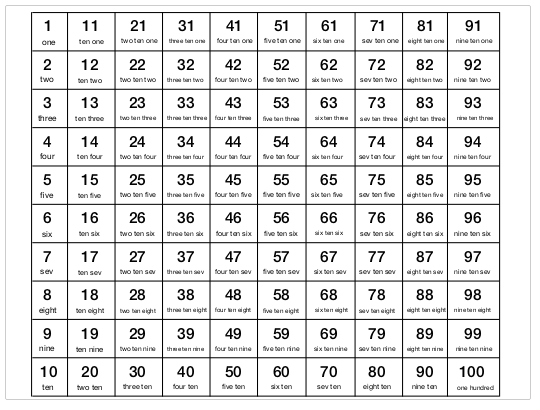
We remove the 17 number words English doesn't need. Irregular words like eleven, twelve, thirteen and twenty don't tell a child anything about place value — they simply have to be memorized. So we drop them, exactly like Chinese does, and let the numbers speak for themselves: 11 is “ten one,” 12 is “ten two,” and 24 is “two ten four.” The words now say what the numbers mean.
Every number from 1 to 10 becomes a single syllable. Nine of them already are; only “seven” has two syllables, so we shorten it to “sev.” That trims the total syllables in one-through-ten from 11 down to 10 — cutting what a child has to hold in mind by nearly 10%. And that matters: working memory holds about as many numbers as a child can say in roughly two seconds, so shorter number words literally let them keep more in their head at once. It's one real reason Chinese-speaking children count and calculate with less effort — fewer syllables, less to juggle, easier math.
Together, these two changes hand English-speaking children almost all of the head start that Chinese number words give — roughly 99% of that free, built-in advantage — except now it's in English, so it's accessible, easy and fun.
Free stuff for math learners!
Want to help a young learner get ahead? It's all free. Use the printables to learn to count 1–100, try the number-word calculator to learn how to say any number up to 15 digits, and watch the video below — real proof that even a preschooler can pick this up.

Math Tutor
Want to interest young children in counting 1-100?
Email us with your available times to set up a free Zoom call.
Email us with your available times to set up a free Zoom call.
4-yr-old learns to count 1-20


Learn More
Login

I'm a Parent

I'm a Teacher
I'm a Student